Banjo bolts, washers and gaskets: copper or aluminium, reuse, and sealant
- Author
- Selami Kumru
- First published
- First published:
- Last updated
- Last updated:
- Reading time
- 6 min read
- Category
- Fittings and selection
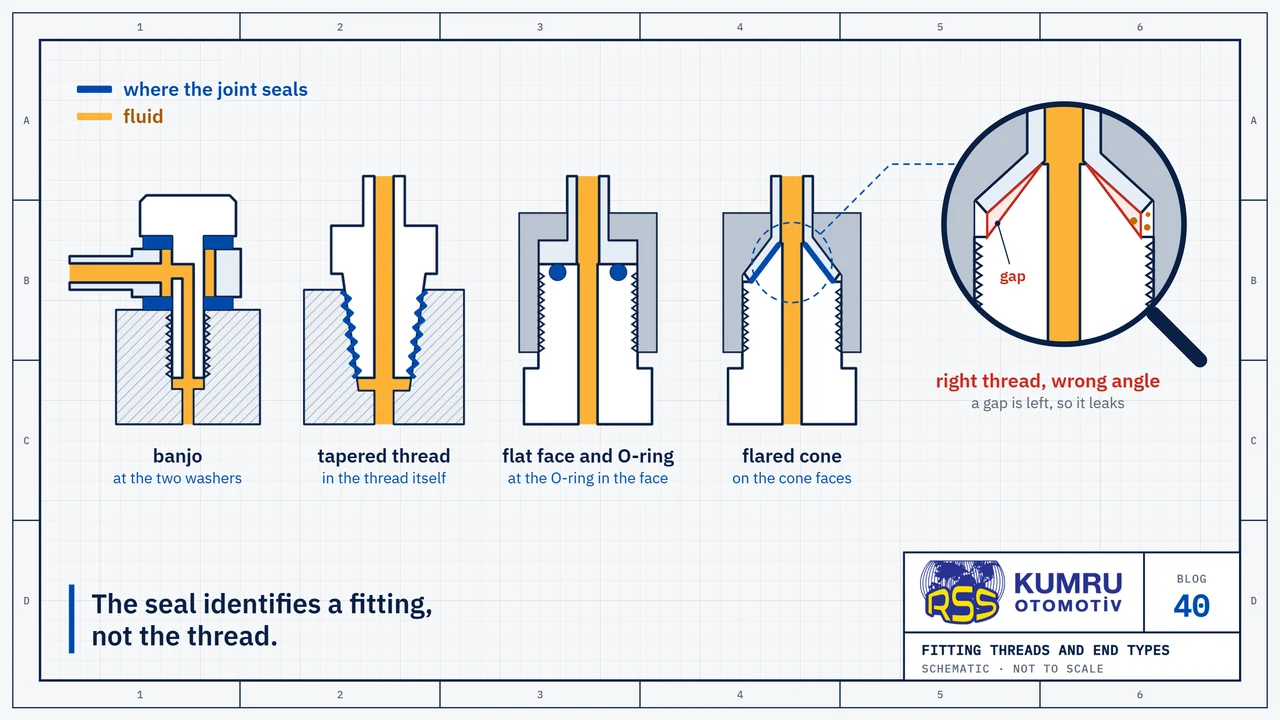
The washers on a banjo bolt are replaced every time the joint is opened, in the material the engine maker chose for that joint, and no sealant goes on them. Those rules are for banjo joints only. The coned end of a high-pressure injector line has no washer or gasket, and a leak there has a different cure.
Short answer
- Copper or aluminium: whichever came off and whichever the parts list names. One catalogue rates copper washers to 300 °C and aluminium to 200 °C.
- Reuse: every manufacturer instruction we opened has the old washers thrown away. Annealing a copper washer is a field fix, not an instruction.
- Sealant: none. Anything that breaks off can block an oil passage.
- Torque: there is no general banjo bolt torque. The figure comes from the service data for that engine.
What is the difference between a banjo joint and a coned joint?
On a banjo joint the pipe ends in a ring. A hollow bolt passes through the ring and screws into the housing, and the oil or fuel flows through the drilling in the bolt. A soft metal washer on each face of the ring makes the seal. A coned joint has nothing in between: the nut presses the cone of the pipe onto its seat, steel on steel.
Both kinds sit side by side on the same engine. In Detroit Diesel’s service information for the DD13, DD15 and DD16, the high-pressure line for cylinder six is held by a nut, while the return line of the pressure limiting valve beside it has a banjo bolt and sealing washers. If you are looking for the washer on an injector line, look at a return line with a banjo bolt, not at the high-pressure pipe. A weeping coned joint has its own article.
One pipe can have both kinds of end: Hyundai’s Theta 2.0 turbo oil feed hose meets the turbocharger with a banjo bolt and two copper washers, and the cylinder block with a flange and one gasket. The bulletin’s rule covers both: “DO NOT reuse the gaskets.”
Should the washer be copper or aluminium?
Whichever you took off and whichever the engine’s parts list names. Both metals work the same way. Of its DIN 7603 sealing washers the standard-parts supplier norelem says: “Thanks to their soft structure, they mould themselves into any unevenness in the parts being screwed together, thus ensuring a tight seal.”
The difference shows in temperature. The catalogue gives “Copper max. 300 °C” and “Aluminium max. 200 °C”, subject to testing “under the specific conditions of use”. In Hyundai’s bulletin the washers for the banjo bolt on the turbocharger are copper.
On a tractor forum one contributor prefers aluminium washers because they are softer and less prone to leaking, but none of the manufacturer documents we opened says the material may be changed.
Torque is another reason to leave the material alone: the figure in the service data was set for the washer that belongs in that joint, and a different metal may not crush the same way at that torque. No instruction says so in those words; it is our conclusion from how the washer works.
Can a washer be reused?
None of the manufacturer instructions we opened puts an old washer back. Hyundai is explicit about the banjo bolt of its turbo oil feed hose:
“Discard the (2) old copper sealing washers and be sure to use (2) new copper washers during reassembly.”
Hyundai, Technical Service Bulletin 16-01-071, December 2016
Detroit Diesel’s return-line procedure reads: remove the banjo bolt “and discard the sealing washers”. Carwood, a turbo remanufacturer, tells fitters of oil feed pipes: “Use new washers and screws, as appropriate”.
The bolt is another matter. The same Hyundai bulletin says: “Retain the banjo bolt for later reuse.” That job is a leaking hose, not a turbo replacement; with a replacement turbo, new banjo bolts are the rule in our article on turbo oil pipes.
Can a copper washer be annealed and refitted?
Annealing a copper washer is a field practice, not a manufacturer instruction. In the same forum thread, about the injector return line of a 1956 Ferguson tractor, the rule comes first: a copper washer is meant to be replaced once used. Then comes the workaround for someone “in a pinch”: heat the washer “up to red heat with a propane torch”, then “Drop it in water, or just let it cool.”
The thread does not agree on why a used washer stops sealing. One contributor finds that used copper washers end up too thin, “not that they get hardened”. Another answers that they crush “just fine a second third or even fourth time”. Both are personal experience. An annealed washer is a stopgap; a new one goes in at the first opportunity, as the manufacturers ask.
Does sealant belong on a banjo washer?
No. The washer is the seal. Hyundai’s procedure wipes the washers clean, cleans the gasket faces and names no sealing compound. Carwood lists liquid sealant among the reasons oil feed pipes fail: “Although it should never be used in the air or oil system, liquid sealant can easily become detached and block oil passages.”
On a banjo bolt the oil passage is the drilling in the bolt itself, which is where sealant squeezed past the inner edge of the washer goes first. Carwood does not say this about banjo bolts; it is our conclusion from how the bolt is built. Our turbo articles cover the same warning for the turbo’s oil flanges.
What is the torque for a banjo bolt?
There is no general torque for a banjo bolt. Each engine maker publishes its own figure for each joint; in the two documents we opened, one is roughly twice the other.
| Engine | Joint | Torque | Document |
|---|---|---|---|
| Detroit Diesel DD13, DD15, DD16 (three-filter fuel system) | Return line of the pressure limiting valve | 30–32 Nm | Service information 6 20-14, June 2014 |
| Hyundai Theta 2.0 turbo (Sonata, Santa Fe Sport) | Turbo oil feed hose, turbocharger end | 1.5 kgf·m (130 lb-in) | Service bulletin 16-01-071, December 2016 |
These figures apply to those joints on those engines only. 1.5 kgf·m is about 15 Nm.
In the same document Detroit Diesel gives 40 Nm for the nut of the high-pressure line on the same rail. A figure for a coned joint does not carry over to a banjo joint, nor one engine’s figure to another. Carwood’s tip for turbo oil feed pipes says the same: “Ensure the pipe is correctly torqued at both ends, as per VM guidelines” (VM: vehicle manufacturer).
In what order does a banjo joint go together?
The sequence is Hyundai’s; the figures come from your own engine’s service data.
- Identify the joint. A nut on a coned pipe end, or a hollow bolt through a banjo? Only the second has washers.
- Compare the new washers with the old ones. Same material, same size.
- Wipe the faces and the washers. No sealant goes in between.
- Fit one washer each side. One above the banjo and one below it. Start the bolt by hand.
- Connect the other end first. Hyundai fits the flange with its new gasket and torques the banjo bolt last.
- Tighten to the figure in the service data. Nothing in the instructions goes beyond it.
- Run the engine and look. Warm it up for several minutes and check both ends for leaks. A joint opened again gets new washers again.
Sources
- Hyundai, “Technical Service Bulletin 16-01-071: Theta 2.0L Turbo Oil Feed Hose Replacement”, service bulletin, December 2016; from the NHTSA archive; Sonata 2.0T and Santa Fe Sport 2.0T.
- Detroit Diesel, “Service information 6 20-14: High Pressure Fuel Injector Lines”, service information, June 2014; from the NHTSA archive; DD13, DD15 and DD16 engines.
- norelem, “Sealing washers DIN 7603, copper, aluminium or stainless steel”, standard-parts catalogue, product page, undated.
- Carwood, “Why the oil feed pipe can fail”, technical article in Professional Motor Mechanic, 27 May 2021.
- TractorByNet, “Banjo bolts on a diesel”, forum thread, June 2017; cited for field practice and disagreement, not a manufacturer instruction.
Sources were checked again on October 8, 2026.
RSS Kumru Automotive
RSS Kumru Automotive was founded in 1990 and specialises in hydraulic systems and fluid management. Our range includes fittings, injector lines, fuel lines and turbo oil pipes.
Brand names and OEM reference numbers are used for identification and compatibility information only.